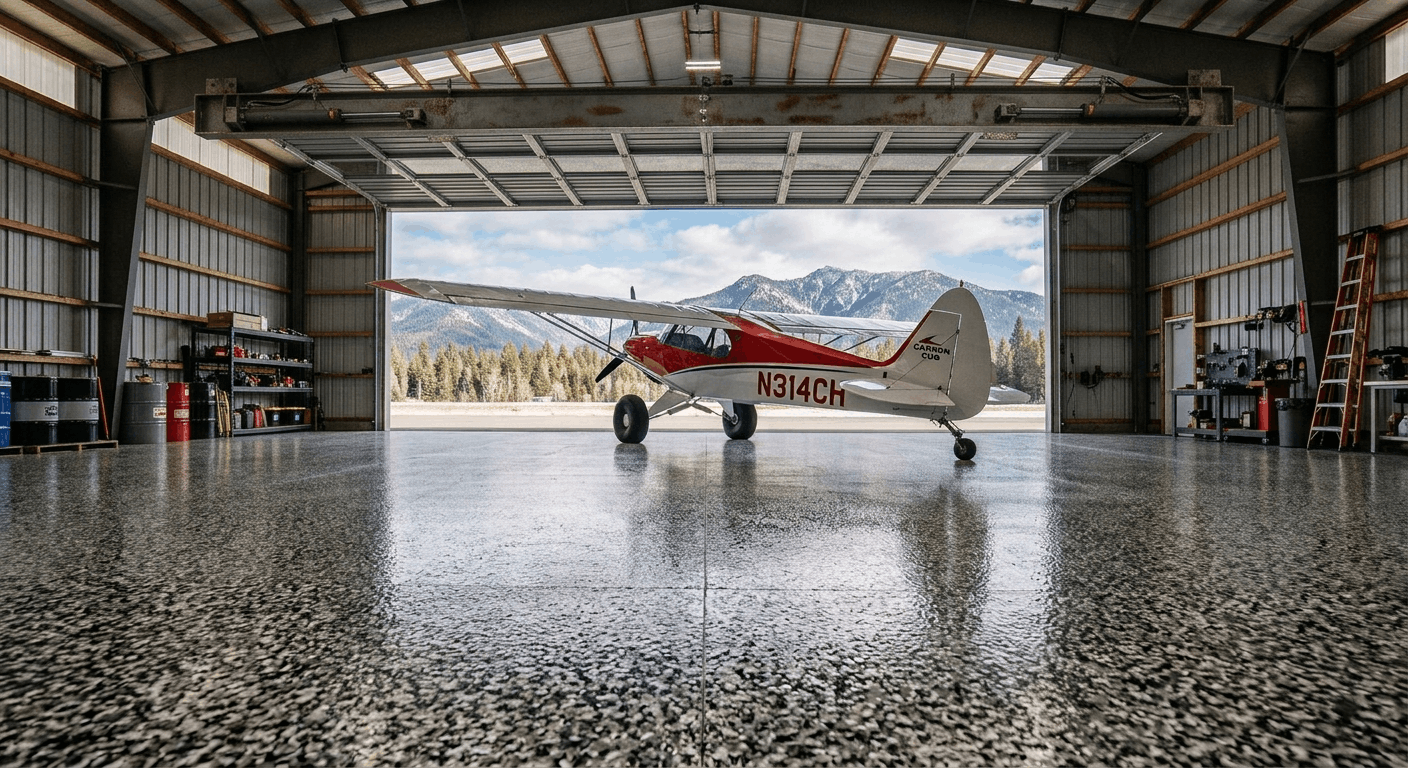
Hangar Floor
Coatings
Tow In Tomorrow
Fuel-resistant, fast-cure, high-load hangar floor coatings, installed nationwide
We install hangar floor coatings that are specified around what actually happens on a hangar deck — dripped Jet A, phosphate-ester hydraulic fluid, nose-gear point loads, tug traffic, and a schedule that will not tolerate a week of downtime. Aviation is all we do on this floor.
A hangar deck fails in ways a shop floor never will
Most contractors quoting hangar floor coatings are really quoting a warehouse floor. The systems look similar on a data sheet and they are not similar in a hangar. Three things separate them, and each one has put a coating on the floor of a dumpster somewhere.
The chemistry is worse. Jet A and 100LL are manageable. Phosphate-ester hydraulic fluid is not — Skydrol will plasticize a standard epoxy and turn a hard film soft and gummy in the exact places it puddles, under the gear and along the wing drip line. Hangar floor coatings have to be specified for the worst fluid that will ever hit them, not the most common one.
The loads are concentrated. A forklift spreads its weight across four contact patches at 60 psi. A Citation's nose tire carries a fraction of the aircraft's weight on a patch the size of your hand at well over 100 psi, and it does it while pivoting. Thin coatings shear and delaminate at exactly that moment.
The building fights you. Hangar doors open onto the ramp. That means wind-driven rain, thermal swings across a slab that may be 200 feet wide, and often no vapor barrier under concrete poured before anyone was thinking about coatings. Getting hangar floor coatings to stick for twenty years is a moisture and prep problem before it is ever a product problem.
Typical Hangar Spec
Reference build- Surface prep
- Diamond grind or shot blast to CSP 2–3, joints and spalls repaired
- Moisture
- ASTM F2170 RH probe; vapor mitigation primer above 80% RH
- Primer
- 100% solids epoxy, penetrating, 6–8 mil
- Body coat
- High-build 100% solids epoxy, 20–25 mil
- Topcoat
- Polyaspartic or aliphatic urethane, UV stable, 6–10 mil
- Total build
- 30–40 mil nominal
- Slip resistance
- Aluminum oxide or polymer grit broadcast in drip zones
- Markings
- Tow lines, tail limits, fire lanes, keep-clear boxes recoated in
- Return to service
- Foot 6 hr · Tow-in 24 hr (polyaspartic build)
Hangar floor coatings, system by system
Hangar Epoxy Flooring
Aircraft hangar epoxy flooring · Highest buildHigh-build 100% solids epoxy at 20–25 mil under a UV-stable, chemical-resistant topcoat — bare epoxy ambers in daylight and a hangar door lets in plenty. The workhorse hangar floor coatings for maintenance hangars, corporate bays, and anywhere the floor takes fluid and abuse daily. Best resurfacing value on a rough or previously coated slab.
Hangar Polyaspartic Coating
Fast cure · 1-day return to servicePolyaspartic hangar floor coatings cure in hours instead of days and stay flexible enough to bridge minor slab movement. Applies down to 0 °F, so an unheated hangar in February is still a workable window. The answer when the aircraft cannot be displaced for a week.
Hangar Floor Paint
Hangar floor paint · Sealers · Budget buildsThe lightest of our hangar floor coatings: thin-film epoxy and urethane paint, or a densified sealer, for tie-down hangars, storage bays, and T-hangar rows where the goal is dust control and light reflectance at the lowest defensible cost. We will tell you honestly when this is enough.
Static-Control & ESD Flooring
Avionics · Composites · Fuel cell repairConductive and static-dissipative hangar floor coatings over a grounded copper grid, verified to ANSI/ESD S20.20 resistance ranges after cure. Required wherever ESD-sensitive avionics are open or fuel vapor is present.
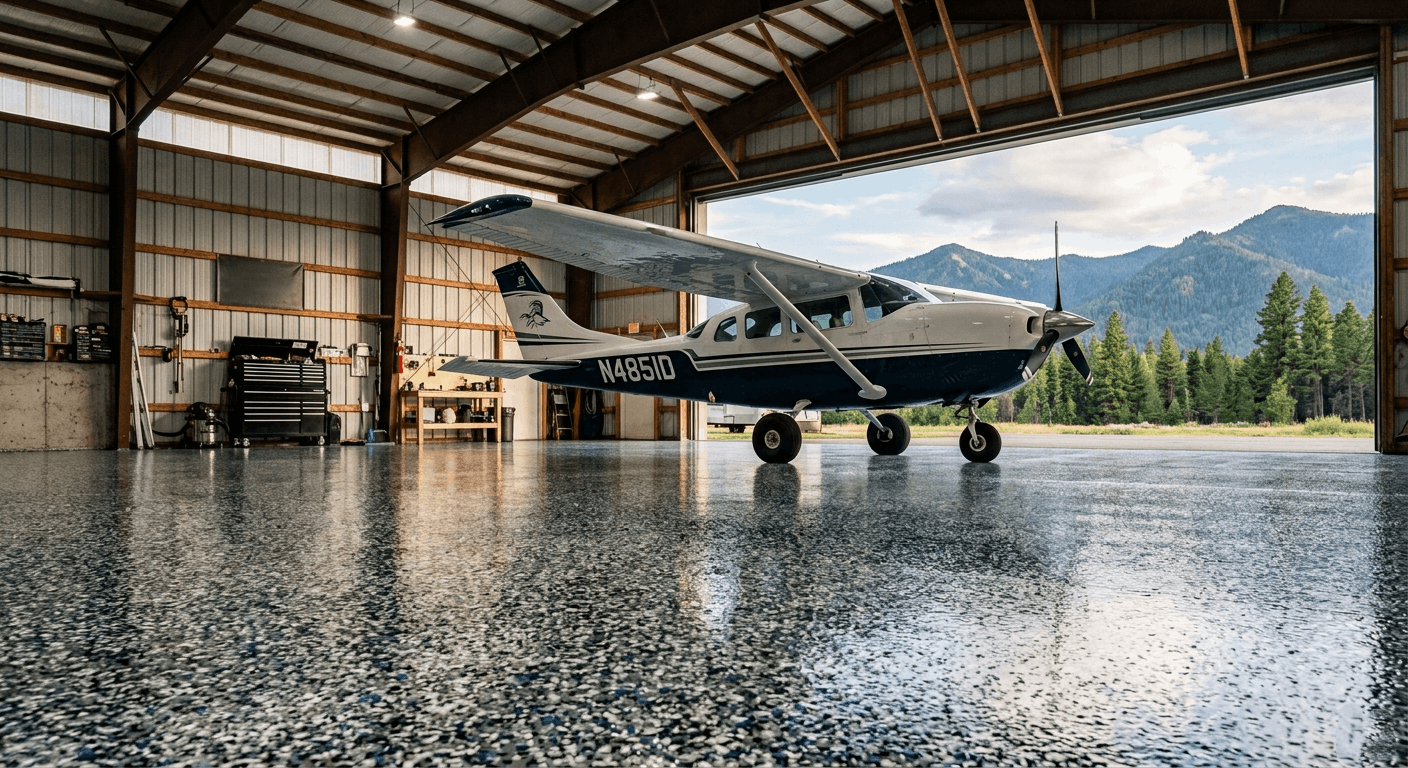
Specified around the fluid, not the brochure
We spec hangar floor coatings around a single question: what lands on this floor? The honest answer is usually a list — Jet A, 100LL, engine oil, deicing fluid, battery electrolyte, solvent from the parts washer, and in transport-category shops, Skydrol.
That list decides the resin. A standard bisphenol-A epoxy handles fuel and oil indefinitely. It does not handle phosphate ester, which slowly softens the film until a wing-drip zone turns tacky and picks up dirt. For those hangars we go to a novolac epoxy body coat or a Skydrol-rated urethane topcoat, and we usually build a heavier, grit-broadcast band beneath the gear positions where the fluid actually lands.
- Jet A, avgas, engine oil, and deicing fluid resistance as a baseline
- Novolac or urethane upgrades where phosphate-ester fluid is present
- Drip-zone detailing under wings, engines, and landing gear
- Chemical-resistance data supplied per product, in writing, before you sign
- Cove base and containment curbs where fluid must not reach a drain
Your hangar is revenue. We treat downtime as a line item.
Hangar floor coatings are bought on schedule as much as on chemistry. An FBO hangar sitting empty is lost tie-down income. An MRO bay sitting empty is a slipped delivery. We schedule hangar floor coatings the way you plan a maintenance event: phased bays, a written cure schedule, and a return-to-service commitment we put in the contract.
Polyaspartic chemistry is the reason we can promise a single-day turnaround. It reaches foot-traffic hardness in four to six hours and tow-in strength in twenty-four, versus seventy-two hours or more for a conventional epoxy. It also cures in the cold, which means a January install in an unheated hangar is a real option rather than a spring wait.
- Bay-by-bay phasing so part of the hangar stays operational
- Night and weekend crews to work around flight schedules
- Return-to-service milestones written into the scope
- Cold-weather application down to 0 °F with polyaspartic
- Dust-controlled grinding with HEPA vacuum shrouds near open aircraft
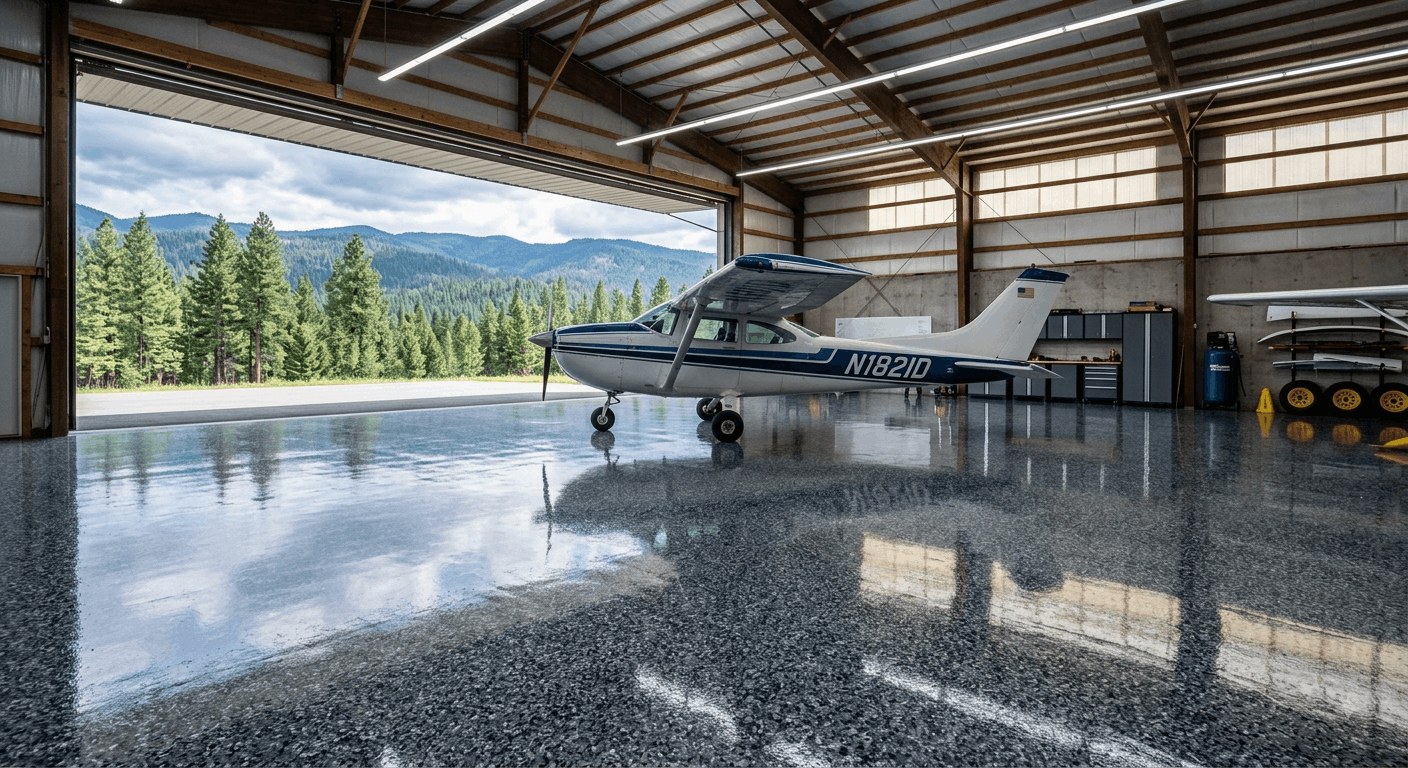
Six reasons this floor outlasts the last one
Hangar floor coatings fail for boring, preventable reasons — moisture, prep, and film thickness, almost every time. These six are how we design those failures out.
We test the slab before we price it
Relative humidity probes per ASTM F2170, a bond pull test, and a look at your joints. Most hangar floor coatings fail on moisture, and moisture is measurable before anyone opens a pail.
Mechanical prep, never acid etch
Diamond grinding or shot blasting to a CSP 2–3 profile. Acid etching leaves residue and an inconsistent profile — it is the cheap shortcut behind most peeling hangar floor coatings.
Mil thickness is in the contract
We state the wet and dry film build per coat and we hit it. A "high-build epoxy" quoted without a number is a quote to spread the material as thin as it will go.
We lay the floor out, not just coat it
Tow lines, tail-limit arcs, fire lanes, extinguisher and keep-clear boxes, tool-cart footprints, and ESD zone boundaries are measured, masked, and coated in — not painted back on with a rattle can afterward. If your hangar has never had a layout, this is where it gets one.
Airport-ready crews
Badging, escort requirements, hot-work permits, FOD discipline, and ramp safety briefings are routine for us. We show up knowing how a movement area works.
Backed by a real company
Hangar Floor Coatings is a service of Crimbo Coatings — a licensed, insured, Google Guaranteed coatings contractor with a decade of industrial floor work behind it.
Four hangar finishes, four different jobs
Colorway and flake size are the last decisions we make, not the first — the resin is chosen for the fluid before anyone opens a color deck. Light does matter, though: a pale, high-gloss floor throws your existing fixtures back up into the airframe, which is the difference between catching a hydraulic weep on a walkaround and missing it. These are representative finishes, not a project archive.
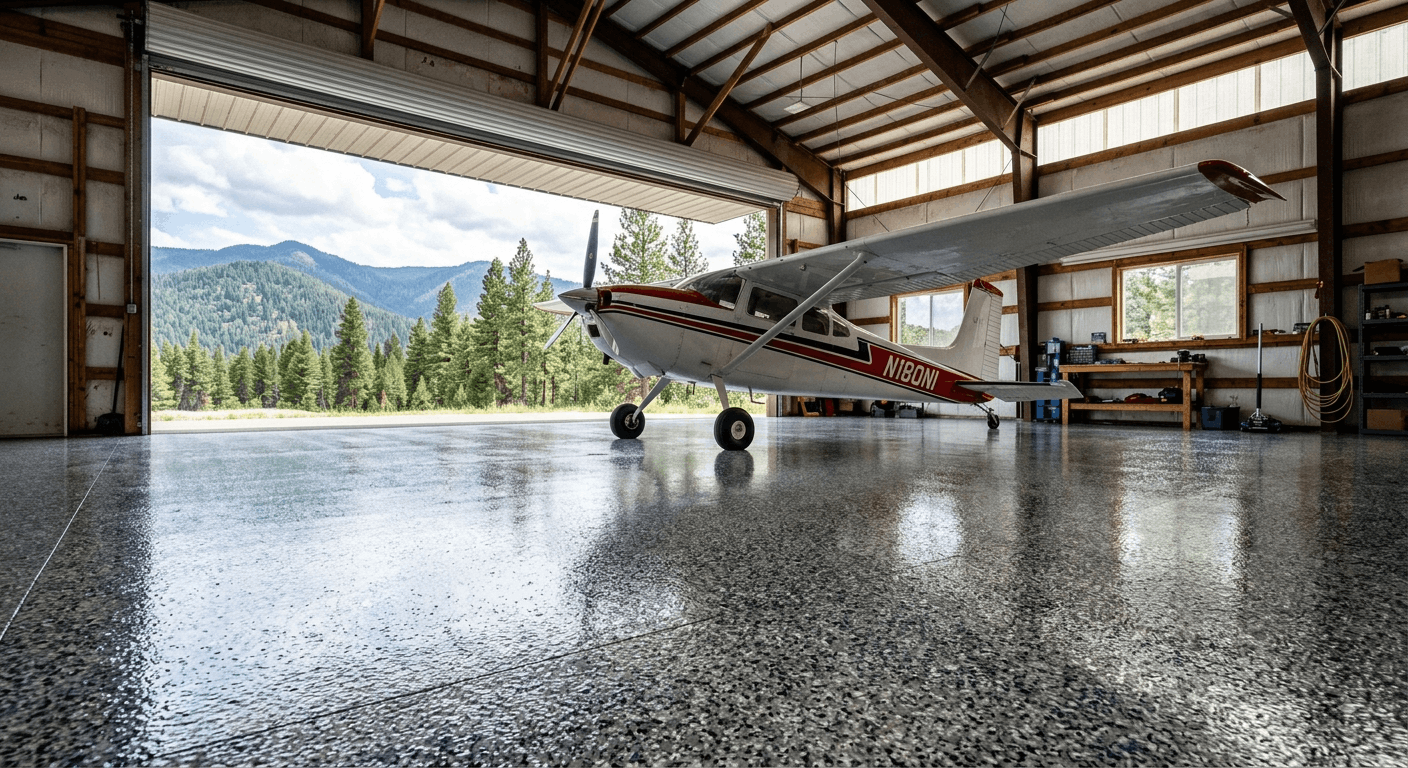 Epoxy
Epoxy
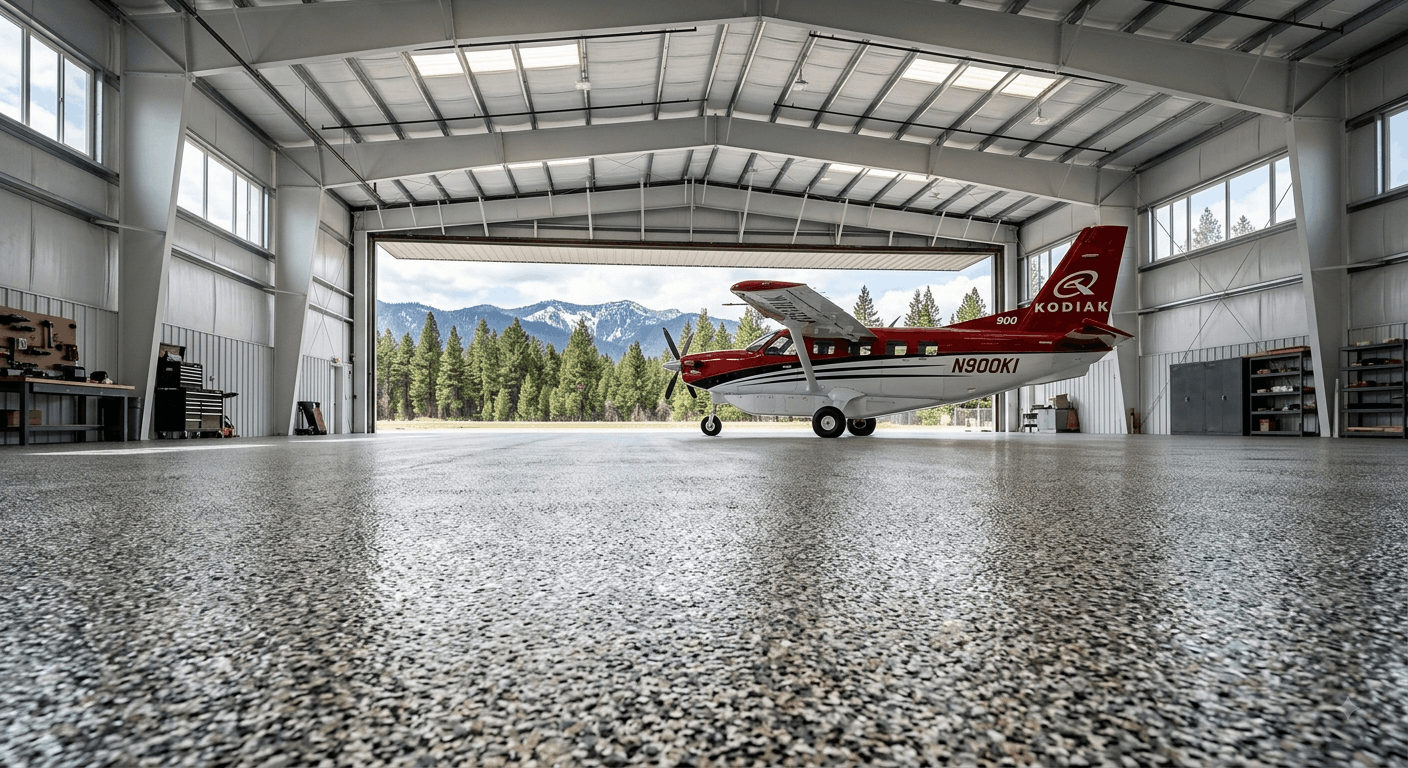 Epoxy
Epoxy
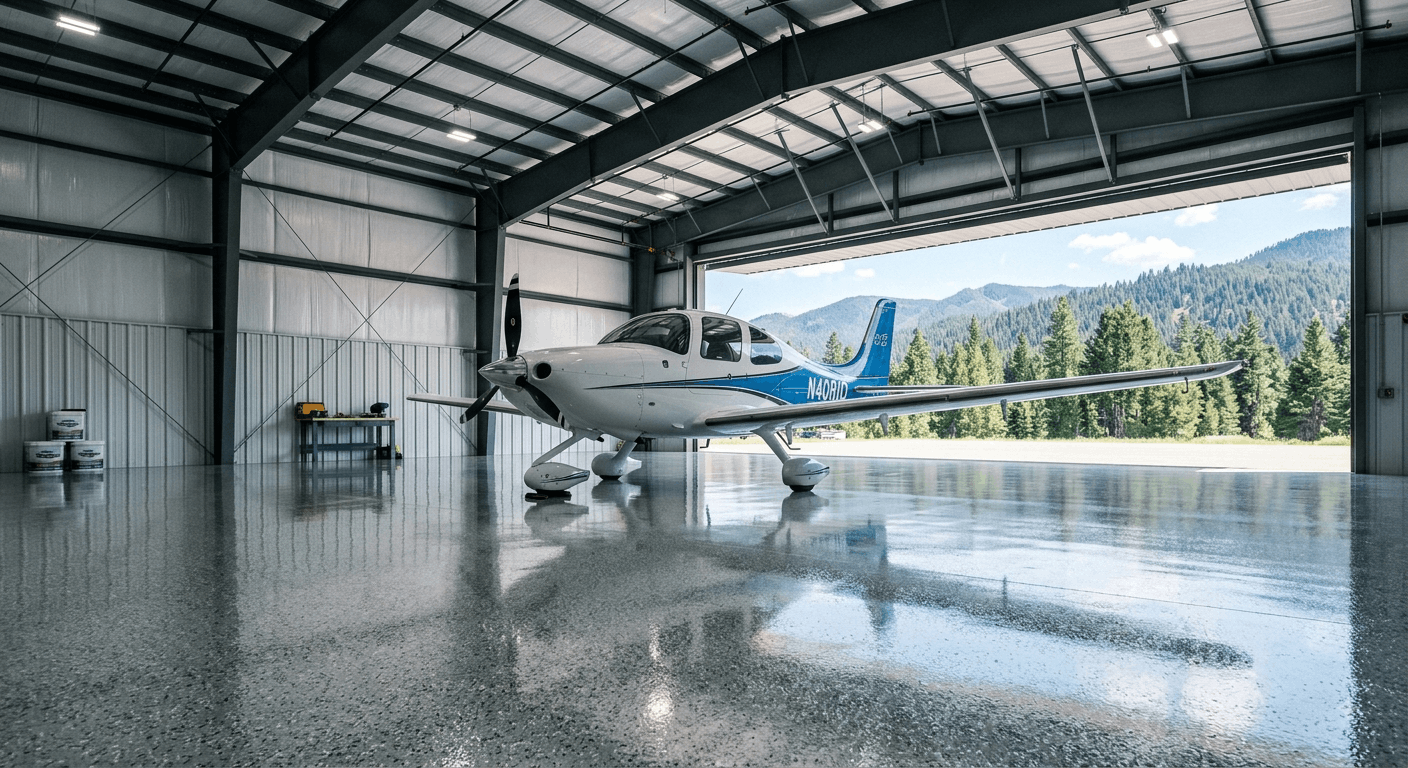 Polyaspartic
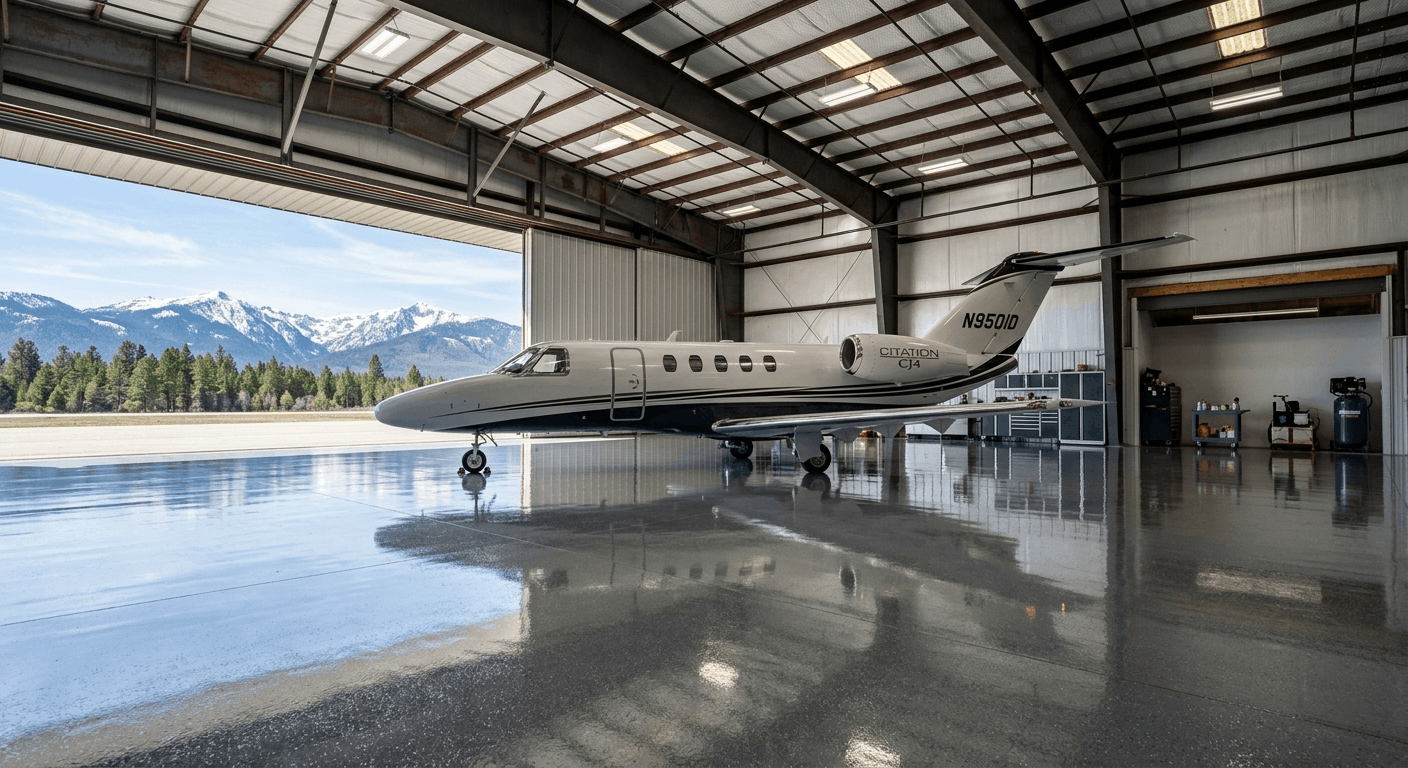 Solid Color
From a single T-hangar to a wide-body MRO bay
Hangar floor coatings are not one product. The chemistry, the build, and the downtime tolerance all change with the mission. These pages go into the requirements specific to each.
Aircraft Hangar Flooring
Hangar floor coatings for storage, corporate, and maintenance hangars — load, chemistry, and marking requirements for general aircraft hangar flooring.
IndustryAviation Flooring
FBOs, flight schools, terminals, and ramps — the wider aviation flooring picture, including strippable coatings.
IndustryAerospace Flooring
Manufacturing, composite layup, avionics, and cleanroom-adjacent aerospace flooring with static control.
Hangar floor coatings, answered
Most hangar floor coatings land between $3 and $9 per square foot installed. A single-coat sealer or hangar floor paint program on sound concrete runs $3 to $4.50. A full-build epoxy hangar floor with a polyaspartic topcoat runs $5.50 to $8. Static-control and Skydrol-resistant hangar floor coatings for MRO bays run $8 to $12. Slab condition drives more of the number than the product does, so we price hangar floor coatings off the slab first — heavy oil saturation, spalling, or a missing vapor barrier all add prep.
With polyaspartic hangar floor coatings, foot traffic is typically 4 to 6 hours after the topcoat and aircraft can be towed back in at 24 hours. Conventional epoxy hangar floor coatings need 72 hours or more before tow-in and up to 7 days before full chemical resistance. If your hangar cannot sit idle for a week, fast-cure hangar floor coatings are the reason that option exists.
Correctly specified hangar floor coatings will. Jet A and avgas are handled by almost any 100% solids epoxy. Phosphate-ester hydraulic fluid — Skydrol, Hyjet — is the aggressive one, and it will soften an ordinary epoxy or a hangar floor paint over time. For transport-category shops we specify novolac epoxy or Skydrol-rated urethane hangar floor coatings, and we detail the drip zones under the wings and landing gear.
Bare epoxy does. Bisphenol-A epoxy ambers under UV, and a hangar with the door open half the day gets plenty of it — the bay nearest the opening goes visibly warmer than the back wall within a couple of seasons. It is a topcoat problem, not a body-coat problem: aliphatic polyaspartic and urethane hangar floor coatings are UV-stable and hold their color, which is why we never leave the epoxy build exposed. If someone quotes you bare epoxy hangar floor coatings, ask what goes over them.
Yes. Hangar floor coatings do not carry the load — the slab does. A 30 to 40 mil build transfers point loads straight into the concrete beneath it, so the limiting factor is your slab thickness and subgrade, not the finish. What hangar floor coatings do have to survive is the tire pressure and scuffing of a nose wheel turned in place, which is why we build a high-solids system with a hard topcoat rather than a thin rolled paint.
They do. Static-dissipative and conductive hangar floor coatings are standard in avionics bays, composite repair shops, fuel cell repair areas, and any zone where you are handling electrostatic discharge sensitive components or working in a fuel vapor environment. These hangar floor coatings use a grounded copper grid under a conductive primer and are tested to ANSI/ESD S20.20 resistance ranges after installation.
Usually. Sound, well-bonded epoxy can be mechanically abraded and recoated, and that is the cheapest route to new hangar floor coatings. Failing, delaminating, or oil-saturated floors have to come off first — recoating over a bad bond just buys you the same failure a year later. We core and pull-test before quoting hangar floor coatings on any previously coated slab.
Twenty more answers — cure schedules, markings, warranties, cold-weather work, and coating over an existing floor — are on the full hangar floor coatings FAQ.
Send us your hangar. We will send you a spec.
We spec hangar floor coatings off three things: the square footage, the aircraft you handle, and how many days you can give up. You will get a written system recommendation with mil thickness, cure schedule, and a real number — at no cost.